
Banpu Harnesses Its Integrated Gas and Power Ecosystem to Strengthen Position for Future Energy Landscape

As the world faces the dual challenges of rising electricity demand and energy transition, the definition of ‘Energy Security’ is undergoing a profound transformation. Traditionally, energy security has focused on ensuring an adequate supply of fuel and electricity to meet a country’s needs. Today it encompasses the ability to deliver energy that is reliable, resilient, and credible in response to increasingly complex and rapidly evolving energy consumption patterns. Energy resilience is no longer merely an enabler of economic growth; it has become a strategic infrastructure imperative that shapes the competitiveness of nations and businesses worldwide. At the same time, the challenge of reducing greenhouse gas emissions is driving future energy systems to strike a balance between energy security and the transition to a low-carbon society.

With more than four decades of experience in the energy business, Banpu Public Company Limited, a leading versatile energy company, has developed a business portfolio that spans the entire energy value chain, from upstream energy resources to power generation, energy storage systems, and energy technologies and solutions across countries around the world. Combined with its efforts to drive carbon emissions reduction, this enables the Company to synergize the strengths of its various businesses to support the development of energy infrastructure that meets the needs of the modern world.

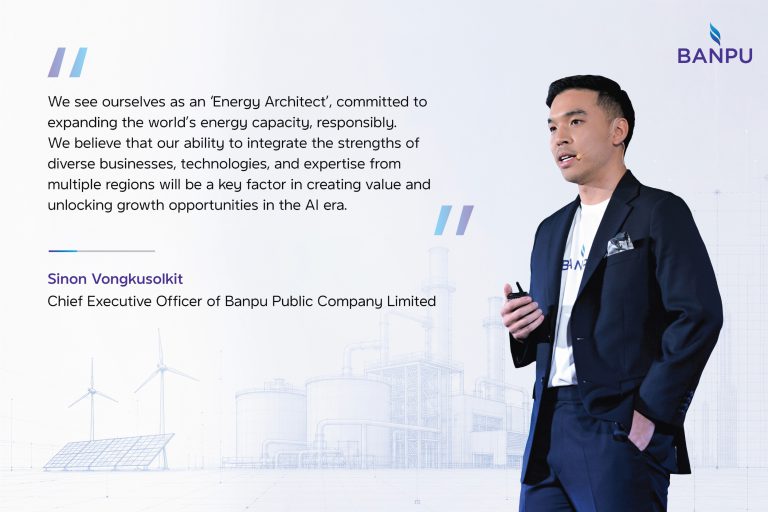
Mr. Sinon Vongkusolkit, Chief Executive Officer of Banpu Public Company Limited, said, “We see ourselves as an ‘Energy Architect’, committed to expanding the world’s energy capacity, responsibly. Our expertise across the energy value chain gives us a holistic view of how different parts of the energy system work together, enabling us to design energy solutions that balance energy security, efficiency, and sustainability. We believe that our ability to integrate the strengths of diverse businesses, technologies, and expertise from multiple regions will be a key factor in creating value and unlocking growth opportunities in the AI era.”

One of Banpu’s key strengths lies in its portfolio spanning from upstream to downstream operations, particularly its closed-loop gas business. It plays a critical role in ensuring the stability and reliability of power systems during the energy transition. In the United States, we have leveraged technology to create additional value through Carbon Capture, Utilization, and Sequestration (CCUS), which has enabled the commercialization of Carbon-Sequestered Gas (CSG)—a carbon-neutral natural gas product. This gas is then used as fuel for power generation, creating a linkage to a Banpu’s power pure-play platform. Renewable energy generation is also incorporated to complement this energy system, enabling us to deliver energy that addresses both energy security and carbon reduction objectives, in line with responding to the growing demand for cleaner energy from the business sector. In parallel, we deploy Battery Energy Storage Systems (BESS) to maintain system balance, manage the intermittency of renewable energy, and enhance grid flexibility, enabling more reliable and efficient energy trading while strengthening Banpu’s competitiveness in merchant power markets. This integrated energy ecosystem positions Banpu to support the world’s next wave of growth, particularly in data centers and digital infrastructure, which requires energy solutions that can simultaneously deliver cost competitiveness, uninterrupted and reliable energy supply, and effective carbon emissions reduction.

The value-creation capability of Banpu’s gas and power businesses stems from the integration of strengths across synergistic businesses throughout the energy value chain. This integrated business structure not only enhances operational efficiency and strengthens competitiveness but also generates cash flow from high-quality assets in key markets, including the United States, China, Australia, Japan, and Indonesia. Meanwhile, the Company is applying digital technologies and artificial intelligence (AI) to enhance asset management efficiency, data analytics capabilities, and business decision-making processes. These technologies bolster the Company’s agility in responding to changing market conditions while enabling it to leverage knowledge and experience gained from operations across multiple regions. This reinforces Banpu’s ability to create value from new growth opportunities emerging in the global energy industry and enhance the readiness of energy systems for the future digital economy.

Banpu remains committed to achieving responsible growth by balancing energy security, economic development, and the advancement of a sustainable energy future through investments in businesses that support the energy transition, efforts to maximize resource efficiency, and the development of technologies that enhance energy efficiency while supporting long-term greenhouse gas emissions reduction. At a time when the world requires more energy than ever before, while simultaneously demanding energy that is cleaner, more flexible, and more reliable, Banpu continues to build on its expertise in energy, technology, and global energy markets. Through these efforts, the Company aims to shape the future-ready energy systems capable of supporting the growth of the digital economy while creating sustainable long-term value for all stakeholders.


###


About Banpu

Banpu Public Company Limited is a leading versatile energy company, operating across four business pillars under its Energy Symphonics Strategy: U.S. Closed-Loop Gas, Next-Gen Mining, Power+, and Future Tech – with operations in Thailand, Indonesia, China, Australia, Lao PDR, Mongolia, Japan, the United States of America, and Vietnam. The Company leads a responsible and sustainable energy transition by balancing reliable, affordable and sustainable energy.

Tags :
For more information,
Please contact Banpu Corporate
Communications Team:
Kankhachee Meecharoen

02-095-6544

kankhachee_m@banpu.co.th

Passaworn Udomsawat

02-095-6415

passaworn_u@banpu.co.th

Solar Farm
Ponder Solar Farm
Texas

Operational

Capacity
(1Q26)

2.5
MW
Banpu Ownership : 100%
Gas-fired Power Plant (HELE/CCGT)
Temple I CCGT Power Plant
Texas

Operational

Installed
capacity
(1Q26)

768
MW
Banpu Ownership : 100%
Temple II CCGT Power Plant
Texas

Operational

Installed
capacity
(1Q26)

755
MW
Banpu Ownership : 100%
Shale Gas Site
Marcellus Shale
Pennsylvania

Operational

Reserves
(2025)

0.6
Tcfe 1P reserves
Banpu Ownership : 65.94%
Barnett Shale
Texas

Operational

Reserves
(2025)

5.5
Tcfe 1P reserves
Banpu Ownership : 65.94%
CCUS Project
Barnett Zero Project
Texas

Operational

Annual CO2
storage capacity
(2025)

183,000
t/yr
Cotton Cove Project
Texas

Operational

Annual CO2
storage capacity
(2025)

32,000
t/yr
CCUS Project
Eagle Ford Project
Southern Texas

Under Development

Annual CO2
storage capacity
(2025)

~90,000
t/yr
East Texas Project
Eastern Texas

Under Development

Annual CO2
storage capacity
(2025)

~70,000
t/yr
BESS Project
Megamouth BESS
Texas

Under Development

Capacity
(2025)

100
MW
200
MWh
Banpu Ownership : 100%
BESS Project
Iwate Tono BESS
Iwate

Operational

Capacity
(1Q26)

15
MW
58
MWh
Banpu Ownership : 75%
BESS Project
Aizu BESS
Fukushima

Under Development

Capacity
(2025)

26
MW
104
MWh
Banpu Ownership : 100%
Tsuno BESS
Miyazaki

Under Development

Capacity
(2025)

26
MW
104
MWh
Banpu Ownership : 70%
Kamigumi-Tokyo BESS
Tokyo

Under Development

Capacity
(2025)

2
MW
8
MWh
Banpu Ownership : 49%
Nikko BESS
Tochigi ​

Under Development

Capacity
(2025)

40
MW
160
MWh
Banpu Ownership : 100%
Hiyoshibaru BESS
Oita​

Under Development

Capacity
(2025)

20
MW
80
MWh
Banpu Ownership : 30%
Solar Power Plant
Olympia Solar
Gunma, Ibaraki and Tochigi

Operational

Capacity
(1Q26)

10
MW
Banpu Ownership : 40%
Yamagata Solar​
Yamagata

Operational

Capacity
(1Q26)

20
MW
Banpu Ownership : 100%
Kesennuma Solar
Miyagi

Operational

Capacity
(1Q26)

20
MW
Banpu Ownership : 100%
Shirakawa Solar​
Fukushima

Operational

Capacity
(1Q26)

10
MW
Banpu Ownership : 100%
Wind Project
Vinh Chau – Phase 1
Soc Trang Province

Under Development

Capacity
(2025)

30
MW
Banpu Ownership : 100%
Solar Power Plant
Nhon Hai Solar
Ninh Thuan Province

Operational

Capacity
(1Q26)

35
MW
Banpu Ownership : 100%
Wind Power Plant
El Wind Mui Dinh
Ninh Thuan Province

Operational

Capacity
(1Q26)

37.60
MW
Banpu Ownership : 100%
Coal Mine
Tsant Uul Mine
South Gobi Province

Operational

Production
(1Q26)

0.57
Mt

Reserves
(2025)

~63.5
Mt
Banpu Ownership : 100%
Coal Project
Unst Khudag Project
Central Gobi Province

Under Development

Reserves
(2025)

540.9
Mt
Banpu Ownership : 100%
Solar Farm
Beryl Solar Farm (BSF)
New South Wales

Operational

Capacity
(1Q26)

110.9
MW
Banpu Ownership : 100%
Manildra Solar Farm (MSF)
New South Wales

Operational

Capacity
(1Q26)

55.9
MW
Banpu Ownership : 100%
Port
NCIG Coal Terminal Port (Newcastle)

Operational

Coal export loading

Coal Mine
Airly Mine
New South Wales

Operational

Production
(1Q26)

0.1
Mt

Reserves
(2025)

13.5
Mt
Banpu Ownership : 100%
Springvale Mine
New South Wales

Operational

Production
(1Q26)

0.7
Mt

Reserves
(2025)

5.3
Mt
Banpu Ownership : 100%
Clarence Mine
New South Wales

Operational

Production
(1Q26)

0.3
Mt

Reserves
(2025)

24.7
Mt
Banpu Ownership : 100%
Mandalong Mine
New South Wales

Operational

Production
(1Q26)

0.5
Mt

Reserves
(2025)

43.9
Mt
Banpu Ownership : 100%
Myuna Mine
New South Wales

Operational

Production
(1Q26)

0.2
Mt

Reserves
(2025)

11.5
Mt
Banpu Ownership : 100%
Angus Place Mine
New South Wales

Care & Maintenance

On care & maintenance

Banpu Ownership : 100%
BESS Project
Wooreen BESS (WESS)
Latrobe Valley

Under Development

Capacity
(2025)

350
MW
1,400
MWh
Banpu Ownership : 50%
Kerang BESS
Latrobe Valley

Under Development

Capacity
(2025)

103
MW
206
MWh
Banpu Ownership : 100%
Coal Project
Newstan Extension Project
New South Wales

Under Development

Reserves
(2025)

51.5
Mt
Banpu Ownership : 100%
Neubecks Mine Project
New South Wales

Under Development

Reserves
(2025)

7.5
Mt
Banpu Ownership : 100%
Wallarah Mine Project
New South Wales

Under Development

Reserves
(2025)

7.8
Mt (equity basis)​
Banpu Ownership : 13.5%
Port
Bontang Coal Terminal
+ 4 ports

Operational

Export loading facility

Coal Project
NPR Mine Project
Central Kalimantan

Under Development

Reserves
(pre-development)

77.4
Mt
Banpu Ownership : 65.14%
Coal Mine
Indominco Mine
East Kalimantan

Operational

Production
(1Q26)

1.6
Mt

Reserves
(2025)

30.4
Mt
Banpu Ownership : 65.14%
Trubaindo Mine
East Kalimantan

Operational

Production
(1Q26)

0.7
Mt

Reserves
(2025)

50.2
Mt
Banpu Ownership : 65.14%
Bharinto Mine
North Barito

Operational

Production
(1Q26)

1.7
Mt

Reserves
(2025)

95.4
Mt
Banpu Ownership : 65.14%
Jorong Mine
South Kalimantan

Operational

Reserves
(2025)

2.3
Mt
Banpu Ownership : 65.14%
Graha Panca Karsa Mine (GPK)
East Kalimantan

Operational

Production
(1Q26)

0.5
Mt

Reserves
(2025)

99.1
Mt
Banpu Ownership : 65.14%
TIS Mine
East Kalimantan

Operational

Production
(1Q26)

0.1
Mt

Reserves
(2025)

7.2
Mt
Banpu Ownership : 65.14%
NPR Mine

Operational

Production
(1Q26)

0.1
Mt

Reserves
(2025)

77.4
Mt
Banpu Ownership : 65.14%
Thermal Power Plant
Hongsa Power Plant – HPC
Xayaboury Province

Operational

Installed Capacity
(1Q26)

1,878
MW
Banpu Ownership : 40%
Thermal Power Plant
BLCP Power Plant
Rayong Province

Operational

Installed Capacity
(1Q26)

1,434
MW
Banpu Ownership : 50%
Solar Project
Jinhu Qianfeng Solar
Jiangsu Province

Under Development

Capacity
(2025)

120
MW
Banpu Ownership : 10%
BESS Project
Jinhu Qianfeng BESS
Jiangsu Province

Under Development

Capacity
(2025)

10
MW
20
MWh
Banpu Ownership : 100%
Thermal Power Plants
Luannan CHP
Hebei Province

Operational

Capacity
(1Q26)

246
MW

Steam
(1Q26)

538
t/hr​
Banpu Ownership : 100%
Zhengding CHP
Hebei Province

Operational

Capacity
(1Q26)

139
MW

Steam
(1Q26)

370
t/hr​
Banpu Ownership : 100%
Zouping CHP
Shandong Province

Operational

Capacity
(1Q26)

223
MW

Steam
(1Q26)

600
t/hr​
Banpu Ownership : 70%
Shanxi Lu Guang (SLG) Power Plant​
Shanxi Province

Operational

Capacity
(1Q26)

1,320
MW
Banpu Ownership : 30%
Solar Power Plant
Huineng Solar
Shandong Province

Operational

Capacity
(1Q26)

21.51
MW
Banpu Ownership : 100%
Jinshan Solar
Shandong Province

Operational

Capacity
(1Q26)

28.95
MW
Banpu Ownership : 100%
Haoyuan Solar
Shandong Province

Operational

Capacity
(1Q26)

20.00
MW
Banpu Ownership : 100%
Hui'en Solar
Shandong Province

Operational

Capacity
(1Q26)

19.70
MW
Banpu Ownership : 100%
Deyuan Solar
Zhejiang Province

Operational

Capacity
(1Q26)

51.64
MW
Banpu Ownership : 100%
Xingyu Solar
Shandong Province

Operational

Capacity
(1Q26)

10.30
MW
Banpu Ownership : 100%
Jixin Solar
Jiangsu Province

Operational

Capacity
(1Q26)

25.22
MW
Banpu Ownership : 100%
Coal Mine
Gaohe Mine
Shanxi Province

Operational

Production
(1Q26)

2.6
Mt

Reserves
(2025)

72.9
Mt
Banpu Ownership : 45%
Hebi Mine
Henan Province

Operational

Production
(1Q26)

0.3
Mt

Reserves
(2025)

40.6
Mt
Banpu Ownership : 40%

IR Contacts