
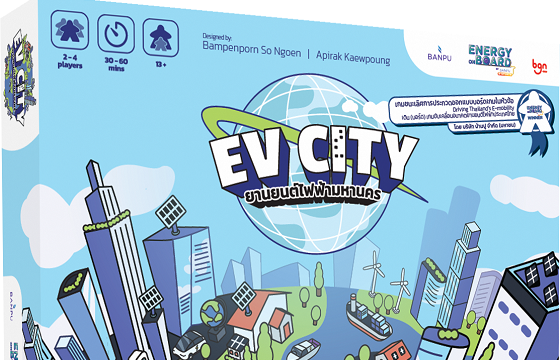
Banpu Introduces ‘EV City’ Board Game Inviting Young Generation to Join in Driving Electric Vehicle Industry Forward

Banpu Public Company Limited, an international versatile energy provider, is ready to bring fun and knowledge to let young generation to learn more about electric vehicle industry through ‘EV City’ board game. Designed by TU Next, a team of students from Thammasat University which won a board game design contest under the project of “Energy on Board by BANPU B-Sports Thailand 2021” with the topic “Driving Thailand’s E-mobility”, the game was developed in collaboration with Board Game Night (BGN) with an aim to drive the future of electric vehicle in Thailand forward and promote more understanding about electric vehicle for young generation.
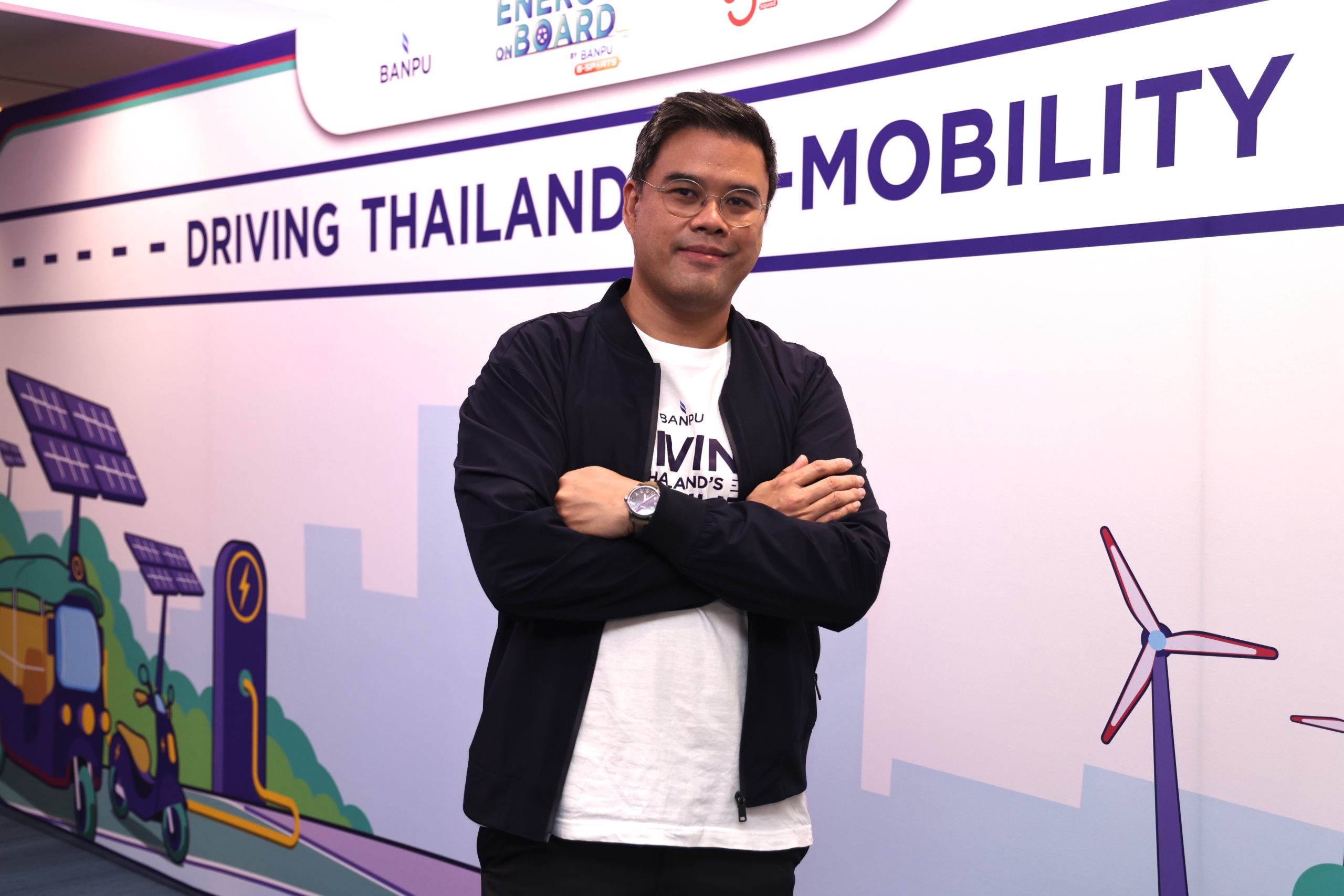
Mr. Rattapon Sukhunthee, Head of Corporate Communications of Banpu Public Company Limited, said, “Over the past four years that Banpu has been working on the BANPU B-Sports Thailand project to promote creative learning through board game, our initial purpose was to encourage young generation who joined the project to develop their soft skills and learn more knowledge relating to energy which was included in the activity and the process of designing board game. At the end of last year, through our “Energy on Board” board game contest, we had “EV City” as the winning game. It was a board game that can communicate clearly about electric vehicle industry development, which is a topic that is on everyone’s attention currently, not to mention that it was a fun and easy-to-understand game.”

The success of this board game came from the idea of the students from the TU Next team and the team from Banpu’s E-Mobility business that helped mentor and shared their knowledge and understanding about electric vehicle development. The creation of this board game was in line with Banpu’s business direction and strategy that are transitioning towards Greener & Smarter energy delivery. Banpu is also committed to being one of the key enablers that drive the future of electric vehicle in Thailand as well as promoting knowledge and understanding of the electric vehicle industry for public. Banpu hopes that EV City board game will be a starting point and an inspiration to those who play the game, to want to participate in driving the growth of electric vehicle industry in Thailand and push forward the transition of our country to a low-carbon society in the future.
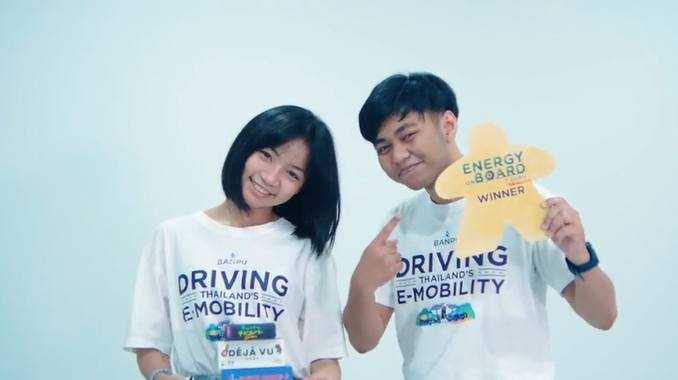
Mr. Apirak Kaewpoung, a third-year student from the Faculty of Liberal Arts, majoring in Geography, and Ms. Bampenporn So Ngoen, a second-year student from the College of Interdisciplinary Studies, major in Data Science and Innovation, Thammasat University, two members of ‘TU Next’ team who created the EV City game, said, “This game was inspired by the government 30/30 policy that aims to push Thailand towards having Zero Emission Vehicle (ZEV) at least 30% of domestic vehicle production by 2030. The challenging part of this game is that the players will take on the role of electric vehicle and charging station manufacturing company depending on the market demand. Also, the players must take turn and play a role of “President of EV Industry Association in the EV City” to launch policies which will be important factors for the industry and electric vehicle operators. The mechanism and the game’s plot are based on what drives the electric vehicle industry in the real world, for example, the game will have association policy cards, electric vehicle demand cards and various types of electric vehicles and charging stations, as well as supply and demand principles related to cost volatility of equipment. The players could win this game by responding well enough to the needs of the market while fostering the future of electric vehicles of the city to reach its goal and make the most revenue”.

Before it became an actual EV City board game, this game’s artwork was developed by game illustrator Mr. Phuwadon Thongnoum or Bui who told us that “The challenging part of the illustration of this game is to make a very detailed story about the electric vehicle industry that seems to be a complicated matter to be easier to understand. Therefore, I chose to use the design in the form of isometric or a three-dimensional image that determines the angle of view as the starting point. It has certain angles of tilt and exact proportions which makes the details on the front, sides and top clearly visible in order to reduce the details of the city by showing the entire game area and city plan from top view. Therefore, the players can get an overview of building components of the city. And since the story of the EV City game is fun and based on real-life situations, it becomes a new game that is interesting to follow and new generation who are interested in electric vehicle would be impressed.
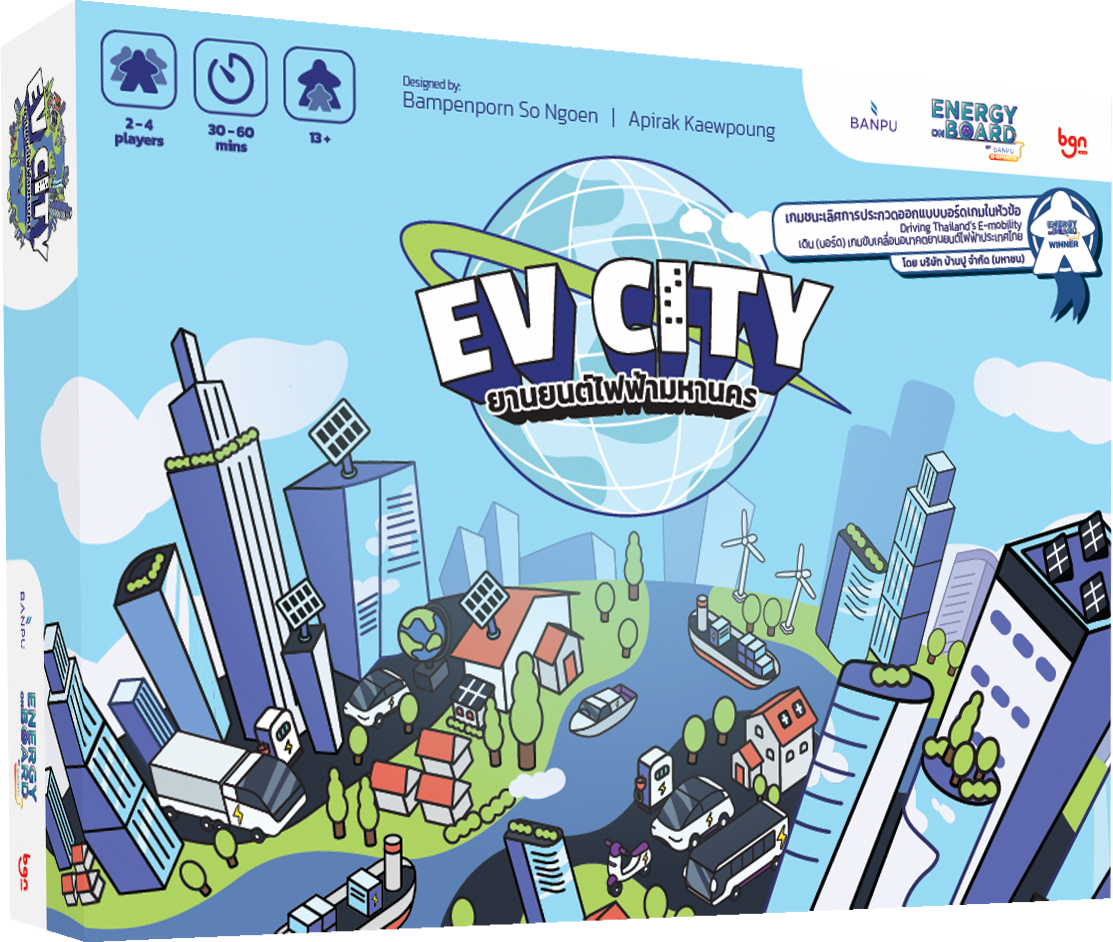
Get ready to have fun with the board game ‘EV City’ soon. Those who are interested can look up on more details, and follow news and activities from the project on Facebook BANPU
B-Sports Thailand at: https://www.facebook.com/BanpuBSportsThailand

 ###

About Energy on Board by Banpu B-Sports Thailand

Banpu Public Company Limited has organized BANPU B-Sports Thailand for the fourth consecutive year, with the aim of supporting board games, a creative learning tool, to be more widely known, especially among young generations because board games help develop soft skills that are essential in current life and work.

About Banpu

Banpu Public Company Limited is an international versatile energy provider with 3 core groups of businesses: energy resources, energy generation and energy technology in 10 countries – Thailand, Indonesia, China, Australia, Lao PDR, Mongolia, Singapore, Japan, the United States of America and Vietnam.

Tags :
For more information,
Please contact Banpu Corporate
Communications Team:
Duangkamol Saleerat

061-446-6698

duangkamol_s@banpu.co.th

Kittiyanee Srihiran

081-909-3003

kittiyanee_s@banpu.co.th

Solar Farm
Ponder Solar Farm
Texas

Operational

Capacity
(1Q26)

2.5
MW
Banpu Ownership : 100%
Gas-fired Power Plant (HELE/CCGT)
Temple I CCGT Power Plant
Texas

Operational

Installed
capacity
(1Q26)

768
MW
Banpu Ownership : 100%
Temple II CCGT Power Plant
Texas

Operational

Installed
capacity
(1Q26)

755
MW
Banpu Ownership : 100%
Shale Gas Site
Marcellus Shale
Pennsylvania

Operational

Reserves
(2025)

0.6
Tcfe 1P reserves
Banpu Ownership : 65.94%
Barnett Shale
Texas

Operational

Reserves
(2025)

5.5
Tcfe 1P reserves
Banpu Ownership : 65.94%
CCUS Project
Barnett Zero Project
Texas

Operational

Annual CO2
storage capacity
(2025)

183,000
t/yr
Cotton Cove Project
Texas

Operational

Annual CO2
storage capacity
(2025)

32,000
t/yr
CCUS Project
Eagle Ford Project
Southern Texas

Under Development

Annual CO2
storage capacity
(2025)

~90,000
t/yr
East Texas Project
Eastern Texas

Under Development

Annual CO2
storage capacity
(2025)

~70,000
t/yr
BESS Project
Megamouth BESS
Texas

Under Development

Capacity
(2025)

100
MW
200
MWh
Banpu Ownership : 100%
BESS Project
Iwate Tono BESS
Iwate

Operational

Capacity
(1Q26)

15
MW
58
MWh
Banpu Ownership : 75%
BESS Project
Aizu BESS
Fukushima

Under Development

Capacity
(2025)

26
MW
104
MWh
Banpu Ownership : 100%
Tsuno BESS
Miyazaki

Under Development

Capacity
(2025)

26
MW
104
MWh
Banpu Ownership : 70%
Kamigumi-Tokyo BESS
Tokyo

Under Development

Capacity
(2025)

2
MW
8
MWh
Banpu Ownership : 49%
Nikko BESS
Tochigi ​

Under Development

Capacity
(2025)

40
MW
160
MWh
Banpu Ownership : 100%
Hiyoshibaru BESS
Oita​

Under Development

Capacity
(2025)

20
MW
80
MWh
Banpu Ownership : 30%
Solar Power Plant
Olympia Solar
Gunma, Ibaraki and Tochigi

Operational

Capacity
(1Q26)

10
MW
Banpu Ownership : 40%
Yamagata Solar​
Yamagata

Operational

Capacity
(1Q26)

20
MW
Banpu Ownership : 100%
Kesennuma Solar
Miyagi

Operational

Capacity
(1Q26)

20
MW
Banpu Ownership : 100%
Shirakawa Solar​
Fukushima

Operational

Capacity
(1Q26)

10
MW
Banpu Ownership : 100%
Wind Project
Vinh Chau – Phase 1
Soc Trang Province

Under Development

Capacity
(2025)

30
MW
Banpu Ownership : 100%
Solar Power Plant
Nhon Hai Solar
Ninh Thuan Province

Operational

Capacity
(1Q26)

35
MW
Banpu Ownership : 100%
Wind Power Plant
El Wind Mui Dinh
Ninh Thuan Province

Operational

Capacity
(1Q26)

37.60
MW
Banpu Ownership : 100%
Coal Mine
Tsant Uul Mine
South Gobi Province

Operational

Production
(1Q26)

0.57
Mt

Reserves
(2025)

~63.5
Mt
Banpu Ownership : 100%
Coal Project
Unst Khudag Project
Central Gobi Province

Under Development

Reserves
(2025)

540.9
Mt
Banpu Ownership : 100%
Solar Farm
Beryl Solar Farm (BSF)
New South Wales

Operational

Capacity
(1Q26)

110.9
MW
Banpu Ownership : 100%
Manildra Solar Farm (MSF)
New South Wales

Operational

Capacity
(1Q26)

55.9
MW
Banpu Ownership : 100%
Port
NCIG Coal Terminal Port (Newcastle)

Operational

Coal export loading

Coal Mine
Airly Mine
New South Wales

Operational

Production
(1Q26)

0.1
Mt

Reserves
(2025)

13.5
Mt
Banpu Ownership : 100%
Springvale Mine
New South Wales

Operational

Production
(1Q26)

0.7
Mt

Reserves
(2025)

5.3
Mt
Banpu Ownership : 100%
Clarence Mine
New South Wales

Operational

Production
(1Q26)

0.3
Mt

Reserves
(2025)

24.7
Mt
Banpu Ownership : 100%
Mandalong Mine
New South Wales

Operational

Production
(1Q26)

0.5
Mt

Reserves
(2025)

43.9
Mt
Banpu Ownership : 100%
Myuna Mine
New South Wales

Operational

Production
(1Q26)

0.2
Mt

Reserves
(2025)

11.5
Mt
Banpu Ownership : 100%
Angus Place Mine
New South Wales

Care & Maintenance

On care & maintenance

Banpu Ownership : 100%
BESS Project
Wooreen BESS (WESS)
Latrobe Valley

Under Development

Capacity
(2025)

350
MW
1,400
MWh
Banpu Ownership : 50%
Kerang BESS
Latrobe Valley

Under Development

Capacity
(2025)

103
MW
206
MWh
Banpu Ownership : 100%
Coal Project
Newstan Extension Project
New South Wales

Under Development

Reserves
(2025)

51.5
Mt
Banpu Ownership : 100%
Neubecks Mine Project
New South Wales

Under Development

Reserves
(2025)

7.5
Mt
Banpu Ownership : 100%
Wallarah Mine Project
New South Wales

Under Development

Reserves
(2025)

7.8
Mt (equity basis)​
Banpu Ownership : 13.5%
Port
Bontang Coal Terminal
+ 4 ports

Operational

Export loading facility

Coal Project
NPR Mine Project
Central Kalimantan

Under Development

Reserves
(pre-development)

77.4
Mt
Banpu Ownership : 65.14%
Coal Mine
Indominco Mine
East Kalimantan

Operational

Production
(1Q26)

1.6
Mt

Reserves
(2025)

30.4
Mt
Banpu Ownership : 65.14%
Trubaindo Mine
East Kalimantan

Operational

Production
(1Q26)

0.7
Mt

Reserves
(2025)

50.2
Mt
Banpu Ownership : 65.14%
Bharinto Mine
North Barito

Operational

Production
(1Q26)

1.7
Mt

Reserves
(2025)

95.4
Mt
Banpu Ownership : 65.14%
Jorong Mine
South Kalimantan

Operational

Reserves
(2025)

2.3
Mt
Banpu Ownership : 65.14%
Graha Panca Karsa Mine (GPK)
East Kalimantan

Operational

Production
(1Q26)

0.5
Mt

Reserves
(2025)

99.1
Mt
Banpu Ownership : 65.14%
TIS Mine
East Kalimantan

Operational

Production
(1Q26)

0.1
Mt

Reserves
(2025)

7.2
Mt
Banpu Ownership : 65.14%
NPR Mine

Operational

Production
(1Q26)

0.1
Mt

Reserves
(2025)

77.4
Mt
Banpu Ownership : 65.14%
Thermal Power Plant
Hongsa Power Plant – HPC
Xayaboury Province

Operational

Installed Capacity
(1Q26)

1,878
MW
Banpu Ownership : 40%
Thermal Power Plant
BLCP Power Plant
Rayong Province

Operational

Installed Capacity
(1Q26)

1,434
MW
Banpu Ownership : 50%
Solar Project
Jinhu Qianfeng Solar
Jiangsu Province

Under Development

Capacity
(2025)

120
MW
Banpu Ownership : 10%
BESS Project
Jinhu Qianfeng BESS
Jiangsu Province

Under Development

Capacity
(2025)

10
MW
20
MWh
Banpu Ownership : 100%
Thermal Power Plants
Luannan CHP
Hebei Province

Operational

Capacity
(1Q26)

246
MW

Steam
(1Q26)

538
t/hr​
Banpu Ownership : 100%
Zhengding CHP
Hebei Province

Operational

Capacity
(1Q26)

139
MW

Steam
(1Q26)

370
t/hr​
Banpu Ownership : 100%
Zouping CHP
Shandong Province

Operational

Capacity
(1Q26)

223
MW

Steam
(1Q26)

600
t/hr​
Banpu Ownership : 70%
Shanxi Lu Guang (SLG) Power Plant​
Shanxi Province

Operational

Capacity
(1Q26)

1,320
MW
Banpu Ownership : 30%
Solar Power Plant
Huineng Solar
Shandong Province

Operational

Capacity
(1Q26)

21.51
MW
Banpu Ownership : 100%
Jinshan Solar
Shandong Province

Operational

Capacity
(1Q26)

28.95
MW
Banpu Ownership : 100%
Haoyuan Solar
Shandong Province

Operational

Capacity
(1Q26)

20.00
MW
Banpu Ownership : 100%
Hui'en Solar
Shandong Province

Operational

Capacity
(1Q26)

19.70
MW
Banpu Ownership : 100%
Deyuan Solar
Zhejiang Province

Operational

Capacity
(1Q26)

51.64
MW
Banpu Ownership : 100%
Xingyu Solar
Shandong Province

Operational

Capacity
(1Q26)

10.30
MW
Banpu Ownership : 100%
Jixin Solar
Jiangsu Province

Operational

Capacity
(1Q26)

25.22
MW
Banpu Ownership : 100%
Coal Mine
Gaohe Mine
Shanxi Province

Operational

Production
(1Q26)

2.6
Mt

Reserves
(2025)

72.9
Mt
Banpu Ownership : 45%
Hebi Mine
Henan Province

Operational

Production
(1Q26)

0.3
Mt

Reserves
(2025)

40.6
Mt
Banpu Ownership : 40%

IR Contacts