
Banpu Advances Decarbonization Roadmap Across Global Portfolios, from Asset Management to People Development, Targeting 20% GHG Emissions Reduction by 2030

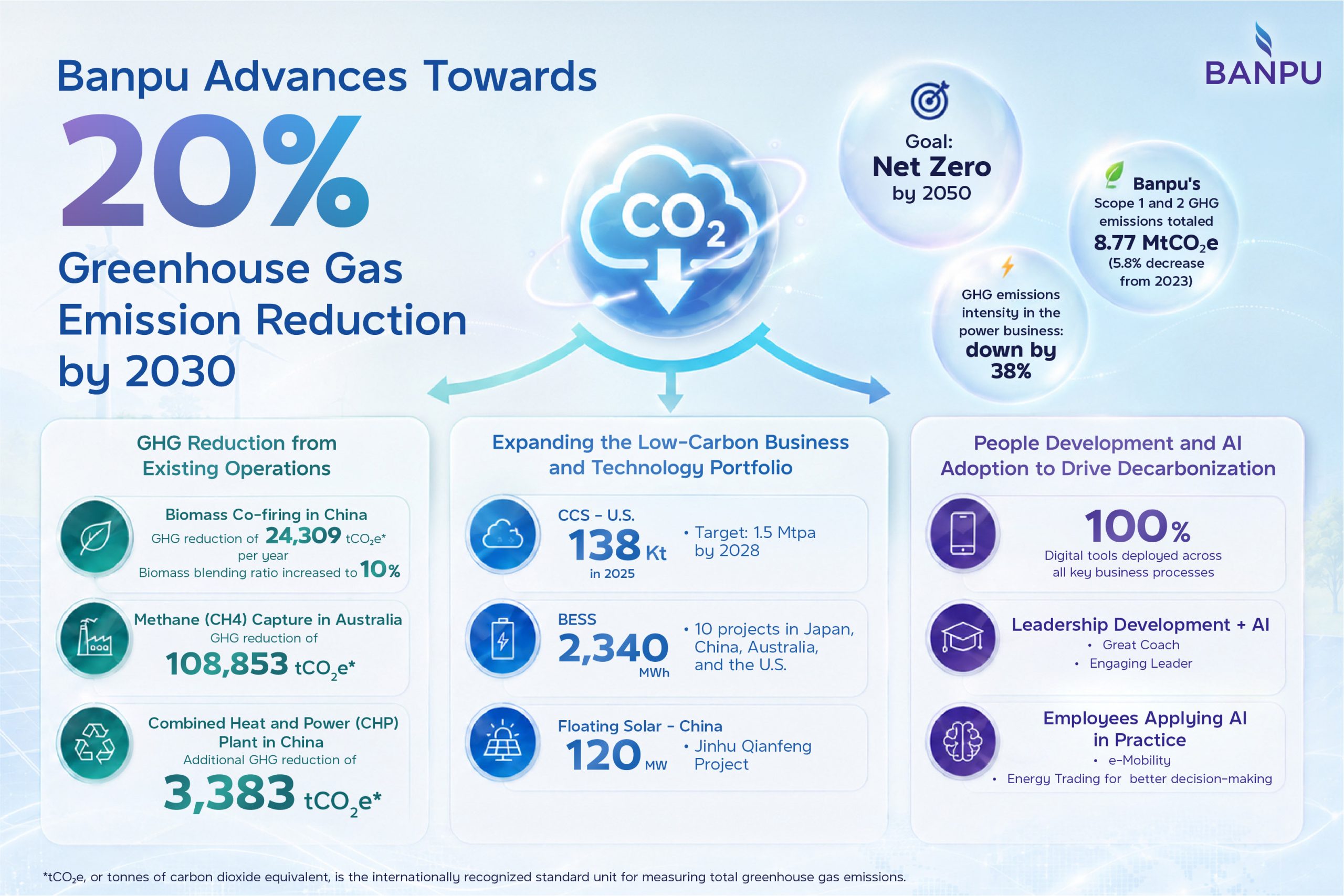
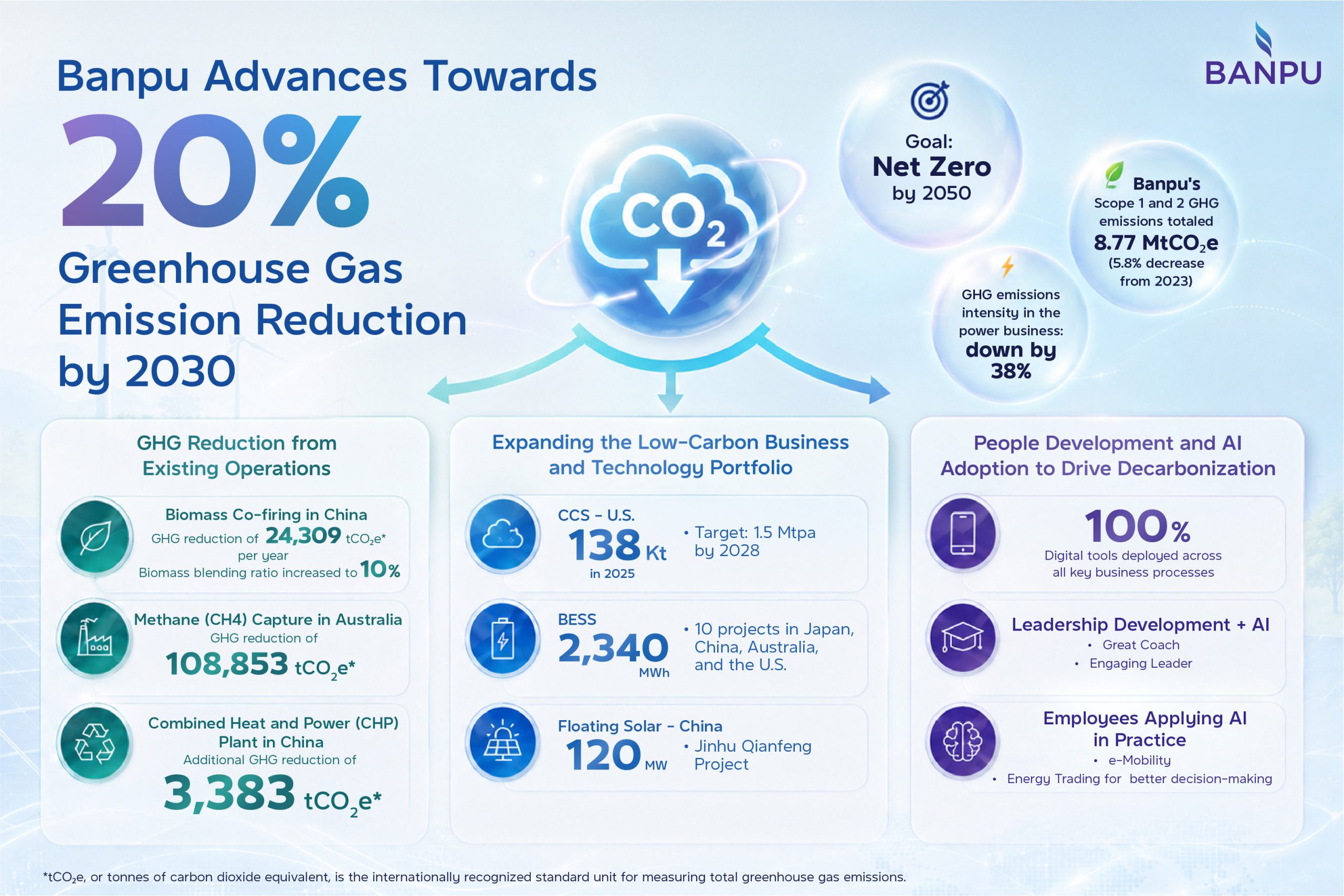
Amid global climate challenges, reducing greenhouse gas (GHG) emissions has become a key priority for businesses worldwide. For Banpu Public Company Limited, this is more than a long-term commitment as it is embedded in the way the Company operates through its Decarbonization Roadmap, which targets a reduction of Scope 1 and 2 GHG emissions by at least 20% by 2030. This roadmap is already delivering measurable progress. In 2025, the Company reduced its Scope 1 and Scope 2 GHG emissions to 8.77 million tonnes of carbon dioxide equivalent (MtCO2e), a 5.8% decrease from the previous reporting period. In power generation, the Company also achieved a 38% reduction in GHG emissions intensity compared to the 2023 base year, reflecting that the transition to a low-carbon energy business is not merely a future ambition, but is already being realized across its operations.

These achievements reflect coordinated efforts across Banpu’s Decarbonization Roadmap, from reducing emissions in current operations and investing in low-carbon businesses and technologies to support future growth, to developing human capital and leveraging digital technologies to accelerate the energy transition.

Start with Existing Operations Before Expansion

Operating across 9 countries with a diversified portfolio spanning multiple energy businesses, Banpu believes the fastest way to accelerate decarbonization is by reducing greenhouse gas (GHG) emissions from its existing assets and operations. The Company has implemented a range of emission-reduction initiatives including the Biomass Co-firing project, which uses biomass and agricultural waste as co-fuel in its China’s power plant, cutting GHG emissions by 28,157 tonnes of CO2 equivalent  (tCO2e). The Zhengding Power Plant aims to increase its biomass blending ratio to 10% by 2026, with an expected annual reduction of 24,309 tCO2e. In Australia, methane (CH4) captured from underground mining is utilized to generate electricity, reducing emissions by 108,853 tCO2e, equivalent to removing nearly 24,000 passenger cars from the road for a year.* Furthermore, Combined Heat and Power (CHP) plants have implemented waste heat recovery from boiler flue gas and installed high-efficiency fans, reducing a further 3,383 tCO2e, equivalent to removing 735 passenger cars from the road for a year.* Banpu also applies an Internal Carbon Pricing mechanism as part of its investment decision-making process to evaluate future carbon costs and ensure all investments align with the transition to a low-carbon economy.

From Decarbonization to Expanding the Low-Carbon Business and Technology Portfolio

Banpu continues to transform its portfolio through strategic investments in low-carbon businesses and technologies to support the long-term energy transition. Through BKV in the United States, the Carbon Capture and Sequestration (CCS) business advances the closed-loop natural gas strategy toward Net Zero. Barnett Zero, the first commercial CCS project, commenced operations with a carbon storage capacity of 183 kilotonnes per annum (ktpa), sequestered 138 kilotonnes CO2e in 2025. The expansion in low-carbon business also continues through projects including Cotton Cove, Eagle Ford, and East Texas, targeting 1.5 million tonnes per annum (Mtpa) by 2028.

Simultaneously, Banpu has expanded its Battery Energy Storage System (BESS) portfolio to a total storage capacity of 2,340 MWh across 10 projects in 4 countries including Japan, China, Australia, and the United States, enhancing grid flexibility and supporting the transition to a low-carbon energy system. The Megamouth project in Texas is one of the Company’s flagship initiatives, strengthening grid flexibility and stability, enabling greater integration of renewable energy, and accelerating the transition to a low-carbon energy system, alongside Wooreen and Kerang in Australia and Iwate Tono in Japan. In renewable energy, Banpu continues to expand its portfolio across strategic markets. In China, the Company is focused on developing solar power projects to increase the proportion of clean energy in its portfolio. One of the flagship projects is the 120-MW Jinhu Qianfeng aquavoltaic solar project in Jiangsu Province.

Developing People and Advancing Digital and AI Adoption to Accelerate Decarbonization

A successful energy transition requires a workforce equipped with the skills and capabilities to effectively apply technology in practice. Banpu has deployed digital tools across 100% of its key business processes to optimize efficiency, reduce GHG emissions, and support the expansion of its clean energy portfolio. At the same time, leadership initiatives the ‘Great Coach’ and ‘Engaging Leader’ programs help equip employees with the capabilities to work effectively with AI. Currently, AI is being applied across the Company’s businesses, from optimizing vehicle routing in its e-Mobility business to reduce energy consumption and GHG emissions, AI-powered energy trading for enhanced data analysis and decision-making, and AI-assisted talent management to support employee development. These initiatives reinforce Banpu’s decarbonization pathway: Avoiding unnecessary CO2 emissions, Reducing operational CO2 emissions, Removing carbon via CCUS technology, and Offsetting unavoidable carbon emissions through other means such as certified Carbon Credits and Nature-based Solutions projects, ensuring people, technology, and governance synergize to drive a responsible energy transition.

Mr. Sinon Vongkusolkit, Chief Executive Officer of Banpu Public Company Limited, stated: “The transition to a low-carbon economy is not just about investing in technology, but fundamentally transforming how the entire business operates. At Banpu, our purpose is to expand the world’s energy capacity, responsibly. Reducing greenhouse gas emissions is integral to fulfilling that purpose. We believe the transition to a low-carbon business must begin with integrating decarbonization into our own operations, to strike a balance between energy reliability, business growth, and minimizing environmental impact, thereby creating long-term sustainable value for society.”

These achievements demonstrate that Banpu’s Decarbonization provides a clear pathway toward achieving its target of reducing Scope 1 and Scope 2 GHG emissions by at least 20% by 2030. The progress achieved to date reinforces our belief that business growth and a sustainable future can go hand in hand.


*Note: The comparison of carbon dioxide equivalent units to greenhouse gas emissions is based on the U.S. Environmental Protection Agency’s (U.S. EPA) Greenhouse Gas Equivalencies Calculator, using the calculation methods and reference factors published by the U.S. EPA.


###

About Banpu

Banpu Public Company Limited is a versatile energy company, operating across four business pillars under its Energy Symphonics Strategy: U.S. Closed-Loop Gas, Next-Gen Mining,  Power+, and Future Tech – with operations in Thailand, Indonesia, China, Australia, Lao PDR, Mongolia, Japan, the United States of America, and Vietnam. The Company leads a responsible and sustainable energy transition by balancing reliable, affordable and sustainable energy.

Tags :
For more information,
Please contact Banpu Corporate
Communications Team:
Duangkamol Saleerat

061-446-6698

duangkamol_s@banpu.co.th

Papatsorn Kanmaneerat

084-996-5391

papatsorn_k@banpu.co.th

Solar Farm
Ponder Solar Farm
Texas

Operational

Capacity
(1Q26)

2.5
MW
Banpu Ownership : 100%
Gas-fired Power Plant (HELE/CCGT)
Temple I CCGT Power Plant
Texas

Operational

Installed
capacity
(1Q26)

768
MW
Banpu Ownership : 100%
Temple II CCGT Power Plant
Texas

Operational

Installed
capacity
(1Q26)

755
MW
Banpu Ownership : 100%
Shale Gas Site
Marcellus Shale
Pennsylvania

Operational

Reserves
(2025)

0.6
Tcfe 1P reserves
Banpu Ownership : 65.94%
Barnett Shale
Texas

Operational

Reserves
(2025)

5.5
Tcfe 1P reserves
Banpu Ownership : 65.94%
CCUS Project
Barnett Zero Project
Texas

Operational

Annual CO2
storage capacity
(2025)

183,000
t/yr
Cotton Cove Project
Texas

Operational

Annual CO2
storage capacity
(2025)

32,000
t/yr
CCUS Project
Eagle Ford Project
Southern Texas

Under Development

Annual CO2
storage capacity
(2025)

~90,000
t/yr
East Texas Project
Eastern Texas

Under Development

Annual CO2
storage capacity
(2025)

~70,000
t/yr
BESS Project
Megamouth BESS
Texas

Under Development

Capacity
(2025)

100
MW
200
MWh
Banpu Ownership : 100%
BESS Project
Iwate Tono BESS
Iwate

Operational

Capacity
(1Q26)

15
MW
58
MWh
Banpu Ownership : 75%
BESS Project
Aizu BESS
Fukushima

Under Development

Capacity
(2025)

26
MW
104
MWh
Banpu Ownership : 100%
Tsuno BESS
Miyazaki

Under Development

Capacity
(2025)

26
MW
104
MWh
Banpu Ownership : 70%
Kamigumi-Tokyo BESS
Tokyo

Under Development

Capacity
(2025)

2
MW
8
MWh
Banpu Ownership : 49%
Nikko BESS
Tochigi ​

Under Development

Capacity
(2025)

40
MW
160
MWh
Banpu Ownership : 100%
Hiyoshibaru BESS
Oita​

Under Development

Capacity
(2025)

20
MW
80
MWh
Banpu Ownership : 30%
Solar Power Plant
Olympia Solar
Gunma, Ibaraki and Tochigi

Operational

Capacity
(1Q26)

10
MW
Banpu Ownership : 40%
Yamagata Solar​
Yamagata

Operational

Capacity
(1Q26)

20
MW
Banpu Ownership : 100%
Kesennuma Solar
Miyagi

Operational

Capacity
(1Q26)

20
MW
Banpu Ownership : 100%
Shirakawa Solar​
Fukushima

Operational

Capacity
(1Q26)

10
MW
Banpu Ownership : 100%
Wind Project
Vinh Chau – Phase 1
Soc Trang Province

Under Development

Capacity
(2025)

30
MW
Banpu Ownership : 100%
Solar Power Plant
Nhon Hai Solar
Ninh Thuan Province

Operational

Capacity
(1Q26)

35
MW
Banpu Ownership : 100%
Wind Power Plant
El Wind Mui Dinh
Ninh Thuan Province

Operational

Capacity
(1Q26)

37.60
MW
Banpu Ownership : 100%
Coal Mine
Tsant Uul Mine
South Gobi Province

Operational

Production
(1Q26)

0.57
Mt

Reserves
(2025)

~63.5
Mt
Banpu Ownership : 100%
Coal Project
Unst Khudag Project
Central Gobi Province

Under Development

Reserves
(2025)

540.9
Mt
Banpu Ownership : 100%
Solar Farm
Beryl Solar Farm (BSF)
New South Wales

Operational

Capacity
(1Q26)

110.9
MW
Banpu Ownership : 100%
Manildra Solar Farm (MSF)
New South Wales

Operational

Capacity
(1Q26)

55.9
MW
Banpu Ownership : 100%
Port
NCIG Coal Terminal Port (Newcastle)

Operational

Coal export loading

Coal Mine
Airly Mine
New South Wales

Operational

Production
(1Q26)

0.1
Mt

Reserves
(2025)

13.5
Mt
Banpu Ownership : 100%
Springvale Mine
New South Wales

Operational

Production
(1Q26)

0.7
Mt

Reserves
(2025)

5.3
Mt
Banpu Ownership : 100%
Clarence Mine
New South Wales

Operational

Production
(1Q26)

0.3
Mt

Reserves
(2025)

24.7
Mt
Banpu Ownership : 100%
Mandalong Mine
New South Wales

Operational

Production
(1Q26)

0.5
Mt

Reserves
(2025)

43.9
Mt
Banpu Ownership : 100%
Myuna Mine
New South Wales

Operational

Production
(1Q26)

0.2
Mt

Reserves
(2025)

11.5
Mt
Banpu Ownership : 100%
Angus Place Mine
New South Wales

Care & Maintenance

On care & maintenance

Banpu Ownership : 100%
BESS Project
Wooreen BESS (WESS)
Latrobe Valley

Under Development

Capacity
(2025)

350
MW
1,400
MWh
Banpu Ownership : 50%
Kerang BESS
Latrobe Valley

Under Development

Capacity
(2025)

103
MW
206
MWh
Banpu Ownership : 100%
Coal Project
Newstan Extension Project
New South Wales

Under Development

Reserves
(2025)

51.5
Mt
Banpu Ownership : 100%
Neubecks Mine Project
New South Wales

Under Development

Reserves
(2025)

7.5
Mt
Banpu Ownership : 100%
Wallarah Mine Project
New South Wales

Under Development

Reserves
(2025)

7.8
Mt (equity basis)​
Banpu Ownership : 13.5%
Port
Bontang Coal Terminal
+ 4 ports

Operational

Export loading facility

Coal Project
NPR Mine Project
Central Kalimantan

Under Development

Reserves
(pre-development)

77.4
Mt
Banpu Ownership : 65.14%
Coal Mine
Indominco Mine
East Kalimantan

Operational

Production
(1Q26)

1.6
Mt

Reserves
(2025)

30.4
Mt
Banpu Ownership : 65.14%
Trubaindo Mine
East Kalimantan

Operational

Production
(1Q26)

0.7
Mt

Reserves
(2025)

50.2
Mt
Banpu Ownership : 65.14%
Bharinto Mine
North Barito

Operational

Production
(1Q26)

1.7
Mt

Reserves
(2025)

95.4
Mt
Banpu Ownership : 65.14%
Jorong Mine
South Kalimantan

Operational

Reserves
(2025)

2.3
Mt
Banpu Ownership : 65.14%
Graha Panca Karsa Mine (GPK)
East Kalimantan

Operational

Production
(1Q26)

0.5
Mt

Reserves
(2025)

99.1
Mt
Banpu Ownership : 65.14%
TIS Mine
East Kalimantan

Operational

Production
(1Q26)

0.1
Mt

Reserves
(2025)

7.2
Mt
Banpu Ownership : 65.14%
NPR Mine

Operational

Production
(1Q26)

0.1
Mt

Reserves
(2025)

77.4
Mt
Banpu Ownership : 65.14%
Thermal Power Plant
Hongsa Power Plant – HPC
Xayaboury Province

Operational

Installed Capacity
(1Q26)

1,878
MW
Banpu Ownership : 40%
Thermal Power Plant
BLCP Power Plant
Rayong Province

Operational

Installed Capacity
(1Q26)

1,434
MW
Banpu Ownership : 50%
Solar Project
Jinhu Qianfeng Solar
Jiangsu Province

Under Development

Capacity
(2025)

120
MW
Banpu Ownership : 10%
BESS Project
Jinhu Qianfeng BESS
Jiangsu Province

Under Development

Capacity
(2025)

10
MW
20
MWh
Banpu Ownership : 100%
Thermal Power Plants
Luannan CHP
Hebei Province

Operational

Capacity
(1Q26)

246
MW

Steam
(1Q26)

538
t/hr​
Banpu Ownership : 100%
Zhengding CHP
Hebei Province

Operational

Capacity
(1Q26)

139
MW

Steam
(1Q26)

370
t/hr​
Banpu Ownership : 100%
Zouping CHP
Shandong Province

Operational

Capacity
(1Q26)

223
MW

Steam
(1Q26)

600
t/hr​
Banpu Ownership : 70%
Shanxi Lu Guang (SLG) Power Plant​
Shanxi Province

Operational

Capacity
(1Q26)

1,320
MW
Banpu Ownership : 30%
Solar Power Plant
Huineng Solar
Shandong Province

Operational

Capacity
(1Q26)

21.51
MW
Banpu Ownership : 100%
Jinshan Solar
Shandong Province

Operational

Capacity
(1Q26)

28.95
MW
Banpu Ownership : 100%
Haoyuan Solar
Shandong Province

Operational

Capacity
(1Q26)

20.00
MW
Banpu Ownership : 100%
Hui'en Solar
Shandong Province

Operational

Capacity
(1Q26)

19.70
MW
Banpu Ownership : 100%
Deyuan Solar
Zhejiang Province

Operational

Capacity
(1Q26)

51.64
MW
Banpu Ownership : 100%
Xingyu Solar
Shandong Province

Operational

Capacity
(1Q26)

10.30
MW
Banpu Ownership : 100%
Jixin Solar
Jiangsu Province

Operational

Capacity
(1Q26)

25.22
MW
Banpu Ownership : 100%
Coal Mine
Gaohe Mine
Shanxi Province

Operational

Production
(1Q26)

2.6
Mt

Reserves
(2025)

72.9
Mt
Banpu Ownership : 45%
Hebi Mine
Henan Province

Operational

Production
(1Q26)

0.3
Mt

Reserves
(2025)

40.6
Mt
Banpu Ownership : 40%

IR Contacts